
Promo Coupon Applied - $100 Off - Purchase Today
Let This Be The Year You Stop Letting Blood Sugar Run Your Life
Discover your Glucose Type — the real reason the same meal can give you two completely different results.
I'm a type 1 diabetic myself. A doctor once told me, flat out, I'd probably be dead by 30.
A few years into learning to manage this, traveling alone outside Paris, I had a low that got bad, fast — my lips went numb, my legs stopped cooperating, my vision started fading. I ended up in a wheelchair in an ER, and I couldn't communicate enough to explain what was happening to me to get help.
What scared me most wasn't that I'd been careless. I was following every rule my doctor gave me. I was just never taught the system behind the rules.

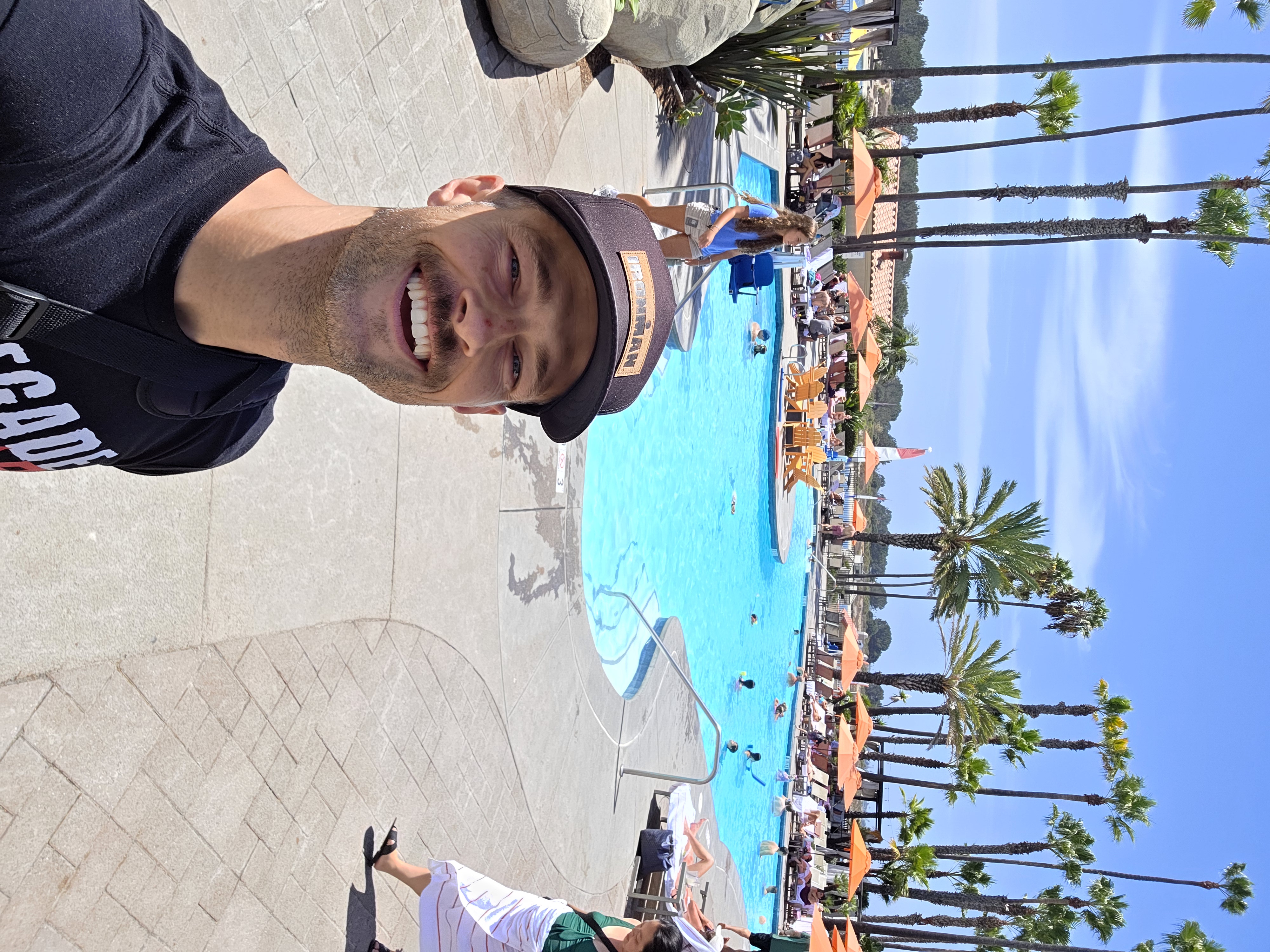
So I built it myself. Tested it on my own body, for years. Today, I've maintained over 90% time in range for more than seven consecutive years. A1C at 5.7, with three lows in the last nine months. I'm thriving — as a dad, a business owner, a globally ranked Ironman athlete — eating and doing whatever I want.
Type 1 diabetics deal with real diabetes distress — the exhaustion of doing everything right and still watching your numbers fight you anyway. It's documented. It's not a personal failing.
There's a name for how it all fits together — specific to you, not the generic version everyone else gets. We call it your Glucose Type. Nobody's ever been able to show you yours — because until now, nothing like this existed.
That's what this event is for.
Right now, you're probably living in one of these three places.
The Over-Controller
Your numbers look great on paper. But you got there by shrinking your life down to six safe foods and zero spontaneity. That's not winning — it's just a more aesthetically pleasing version of stuck.
The Guesser
Your numbers are all over the place and you genuinely don't know why. Same meal, same dose, completely different result. There's a name for what you're paying — the ignorance tax — and nobody's ever explained how to stop paying it.
The Avoider
You've quietly stopped doing things — exercise, travel, spontaneous plans — because the unpredictability isn't worth the risk anymore. It's smaller, but it's safer.
And if none of these quite fit — maybe you're already doing better than most, or you bounce between a few of these depending on the week. Either way, what's coming applies to you too.
The Warrior Who Knows Their Glucose Type
Stable numbers and a full life, at the same time — not one traded for the other. That's the fourth place, and it's the only one built specifically around you instead of a generic protocol. That's what these two days are for.
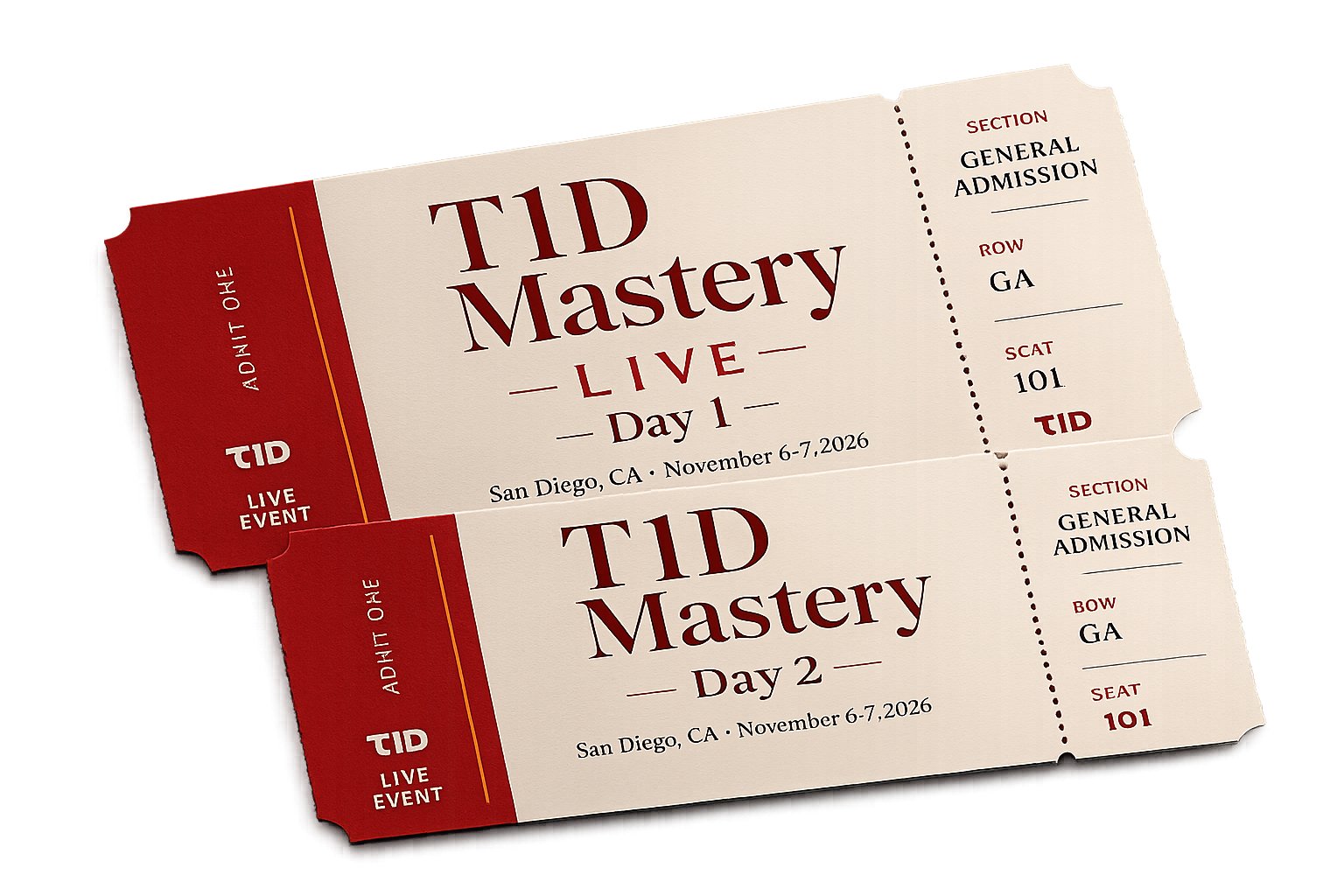
General Admission Ticket
San Diego Mission Bay Resort · November 6–7, 2026
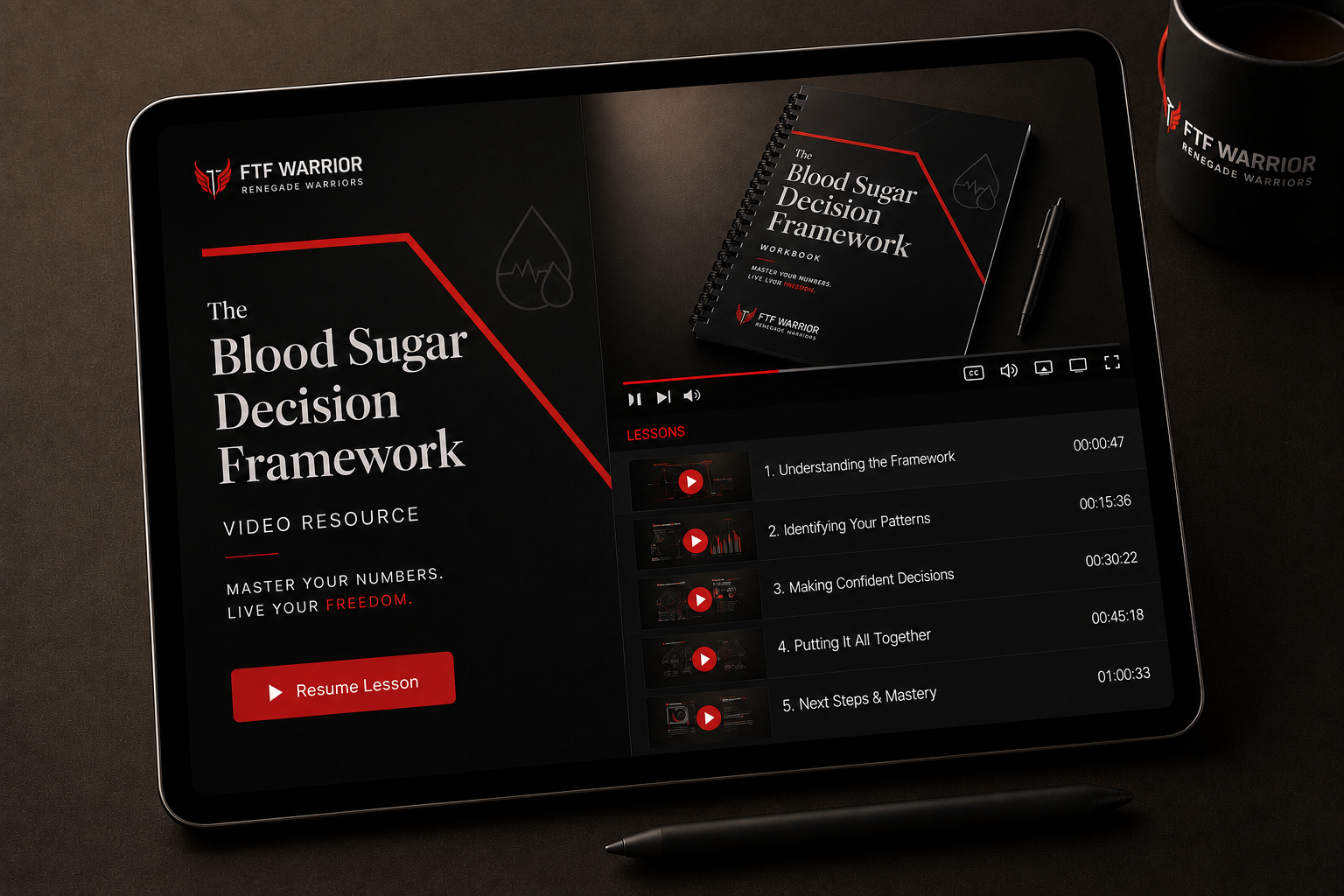
The Blood Sugar Decision Framework
$197 value
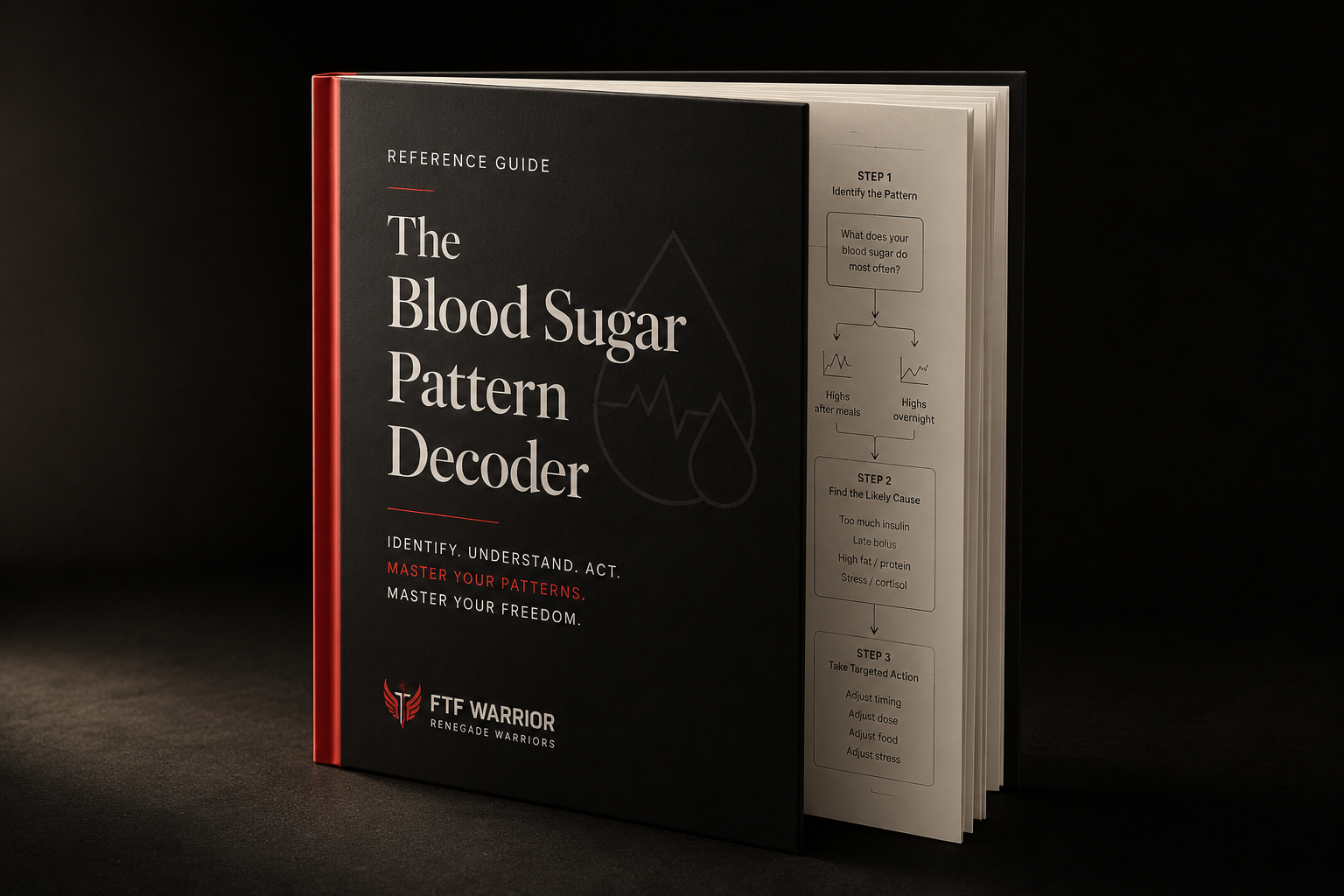
The Blood Sugar Pattern Decoder
$197 value
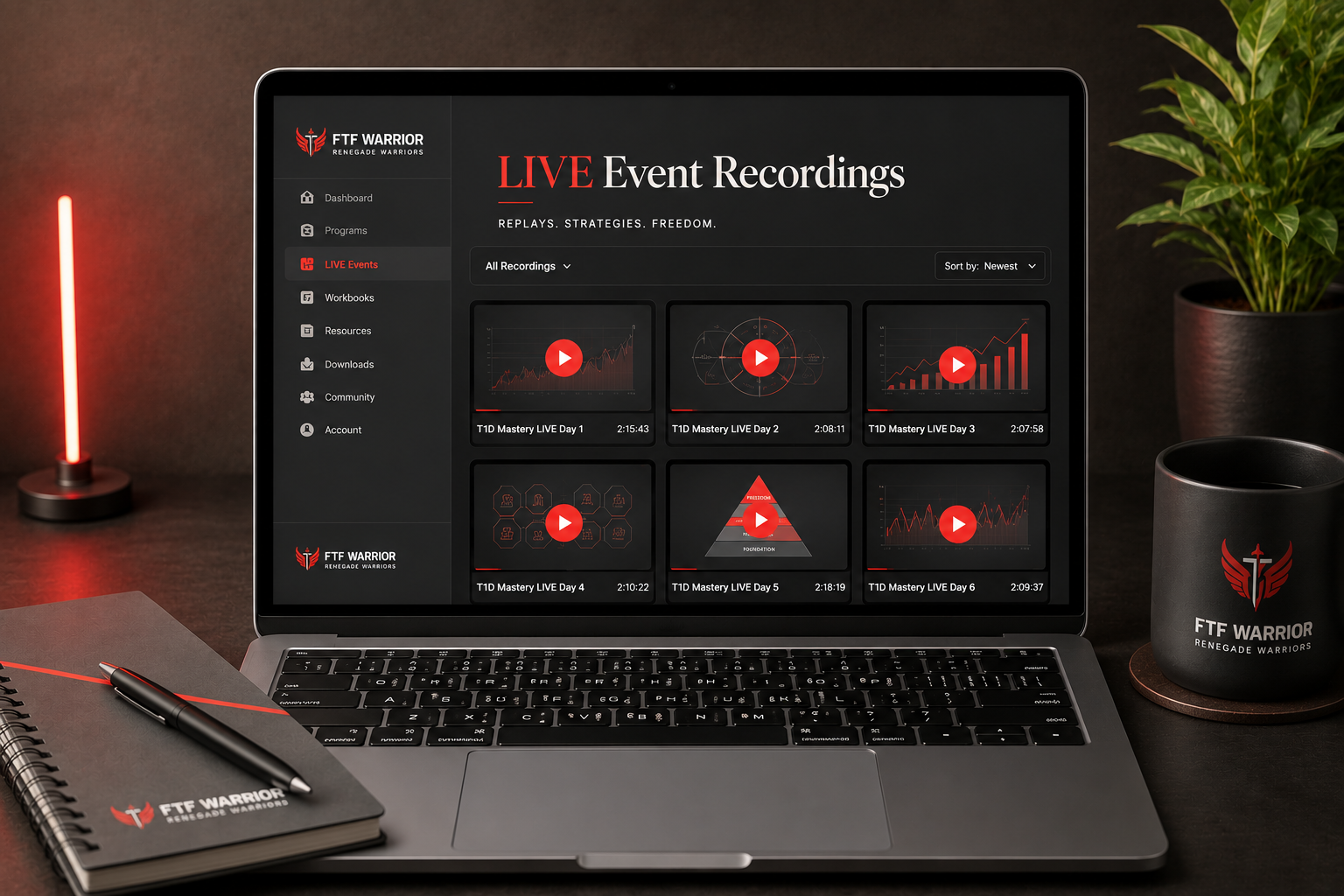
LIVE Event Recordings
$97 value
"Same numbers on paper — completely different life." Mark went from a diabetes so tightly controlled it had taken over his family's life, to actually being present with his kids again, numbers still excellent.
Two years of mapping her patterns took Sarah from white-knuckling every meal to spontaneous dinners out, adjusting on the fly, without the anxiety.
Jessica went from avoiding exercise entirely — convinced her body "just couldn't handle it" — to finishing a local 5K with stable blood sugar throughout.
This Isn't Just Information. It's Everything Information Alone Never Gave You.

Personalization
Not another generic protocol. You'll leave knowing your own Glucose Type — the specific way your own numbers actually work, not the version built for someone else.
Motivation
Reading about this at home and sitting in a room hearing it live are two different experiences. Something shifts when you're actually there — the kind of push that gets you to finally act on what you've known for years.
Community
A room full of other type 1s who are chasing the exact same thing you are — freedom through control, not just a better number on a screen. That kind of room is rare, and you won't find it scrolling a forum at home.
Clarity
You'll walk out with an actual plan, not more open tabs to research later. No more guessing what to try next — just a clear next step, built around your own numbers.
The Real Reason Your Blood Sugar Feels Random (It Isn't) — And What 2 Days In San Diego Can Change About That
No, this doesn't involve eating six pre-approved foods for the rest of your life.
San Diego, CA
Dear Friend,
If a doctor has ever told you your blood sugar "just does that sometimes" —
I need you to hear something that took me nearly dying in a foreign country to learn:
It doesn't "just do that."
Every high. Every low. Every number that makes absolutely no sense.
There's a reason. Every single time.
You've just never been shown how to find it.
Here's what nobody told you at diagnosis. You got a short list of directions — count your carbs, take your insulin, correct the highs, treat the lows. Some of that matters. I'm not throwing it away.
But you didn't get the full picture of how any of it actually interacts, in your real, messy, unpredictable life.
You've been driving cross-country with only the top-left corner of the map filled in. You know roughly which direction to head. You don't know where the roads actually are. So you take wrong turns, you double back, and you keep ending up somewhere you didn't plan to be — even when you feel like you're doing everything right.
I know this because I lived it — you already know the story, the ER outside Paris, the wheelchair, the moment I thought it might actually be over. What I haven't told you yet is what happened after.
I decided to learn it. Not from a textbook — from becoming the test subject in my own research, obsessively, for over two years. And proving the process works from nearly a decade of coaching thousands of type 1s, every age, every background, every device, every diet.
What I found is that your blood sugar isn't random. It's the output of a stack of variables — more than 50 of them — layering on top of each other in real time, every day. Insulin still active from your last dose. How you slept last night. The fat content in what you ate. Whether you worked out yesterday, not just today. Most people are only tracking two or three of those. That's the entire problem.
And this isn't just something I've noticed with my own clients. Researchers studying real-world insulin delivery data have said the same thing publicly — that managing type 1 is far more complex than counting carbs, and that no single approach fits everyone. Your endocrinologist isn't wrong for using a standard protocol. They just don't have more than 15 minutes to build you a personalized one. That's the gap.
We call that gap your Glucose Type — the specific way all fifty-plus variables stack together for YOU, not the generic version. Nobody's ever shown you yours, because before this - it didn't exist.
Once you can see the whole stack instead of just the one number on your screen, something shifts. The chaos stops being chaos. It becomes a puzzle. And puzzles have solutions.
That's what I want to hand you in San Diego this November — through two days, in person, built around your actual numbers, not a hypothetical, diabetes "cookie-cutter" plan.
Maybe you've been asking yourself:
"Is this ever going to stop feeling like a full-time job I never signed up for?"
"Why can I eat the exact same meal twice and get two completely different results?"
"Is the only way to get good numbers to shrink my whole life down to six safe foods and zero spontaneity?"
No. It's not. And I can say that with total confidence, because I've spent the better part of a decade proving it — in my own body, through Ironman races, and through thousands of T1D client transformations.
This isn't a seminar where you sit and take notes for two days and go home with a binder. This is where we build it live — your patterns, your numbers, your actual life — in the room, together.
If you're ready for this to be the year blood sugar stops running your life, this is the room to be in.
Reserve My Seat →What Happens In The Room
Why Your Blood Sugar Actually Does What It Does
You'll finally see the full picture behind your numbers — not just "carbs up, insulin down," but the real stack of variables (sleep, stress, timing, activity, and dozens more) that combine to create every single reading on your CGM. By the end of the day, you'll know your Glucose Type — exactly where you stand right now, and more importantly, exactly why.
How To Actually Use This In Real Life
This is where it gets practical. You'll learn how to adjust for the variables that have been throwing you off for years, and you'll leave with a simple decision-making framework for the moments when two or three things are working against you at once — so you're never just standing there guessing what to do.
This Is For You If...
This Is NOT For You If...
There's More We Haven't Told You Yet.
Every attendee gets full access to Day 1 and Day 2. But there's a third piece to this event — something we're only revealing in person, to the people who show up ready to do the work.
If that's you, we'll see you in San Diego.
Reserve My Seat →Everything You Need To Know
What will I actually learn at this event?
Day 1, you find your Glucose Type — the real reason your numbers do what they do, not another lecture on carbs and insulin. Day 2, we go deeper into the subconscious patterns and tendencies driving your day-to-day behavior, and build your entire plan around all of it — personalized to you, live, in the room. Both days are hands-on, not lecture-and-notes.
Where exactly is it held?
San Diego Mission Bay Resort, 1775 East Mission Bay Drive, San Diego, CA 92109 — November 6-7, 2026. Parking, check-in details, and everything else you need go out directly to everyone who's registered as we get closer to the date.
How much do tickets cost?
$300 for General Admission, which includes both full event days plus the bonuses listed above. Early bird pricing is live right now and won't last.
Do you have hotel recommendations or a room block discount?
Yes. The event is at San Diego Mission Bay Resort, which is also a full hotel, so you can stay right where it happens. Hotel recommendations and room block details will be sent directly to your email once you're registered.
Will there be food? What about dietary restrictions or blood sugar management during the day?
Some meals are provided as part of the event, and there are plenty of nearby options too — including ones that accommodate dietary restrictions.
Will I be able to ask questions and get them answered live?
Yes — this isn't a sit-and-watch event. Both days are built around real questions and real numbers in the room, not a one-way presentation.
What if I can only make one of the two days?
The framework builds across both days — Day 1 is where you find your Glucose Type, Day 2 is where you build your plan around it. You'll get the most out of this by attending both.
Is this refundable?
All ticket sales are final — seats are reserved and paid for ahead of the event.
Is this only for Type 1, or does it apply to LADA, type 1.5, or type 3c too?
If you're insulin-dependent — type 1, LADA, type 1.5, or type 3c — this is built for you.
What should I bring?
Your CGM data and your actual questions. This is built around real numbers in the room, not hypotheticals.
Is this a replacement for my endocrinologist or care team?
No. This isn't a medical intervention and isn't a replacement for your care team — it's the personalized part your care team never has time to build with you in a 15-minute appointment.
FTF Warrior LLC ©2026+ All Rights Reserved